Alt Spreads: Advanced Strategies for Buying and Selling Points

Key Takeaways
- Price Elasticity: The cost of buying or selling points is not linear; crossing key numbers like 3 and 7 in the NFL costs exponentially more than crossing dead numbers.
- The Trap of Buying Points: Buying points as 'insurance' is often -EV due to inflated vig; only buy points when crossing primary key numbers or when a specific model identifies a pricing inefficiency.
- Selling for Value: Selling points (taking a harder spread for plus-money) is a high-variance, offensive strategy ideal for blowout game scripts where the favorite is undervalued.
- Synthetic Hold: Sportsbooks often apply a higher theoretical hold (5-7%) on alternative markets compared to main lines, making line shopping essential to minimize the 'tax' paid.
- Strategic Correlation: Alternative spreads are highly effective in correlated parlays, where a specific game script (e.g., high passing yards) naturally aligns with a larger margin of victory.
Definition
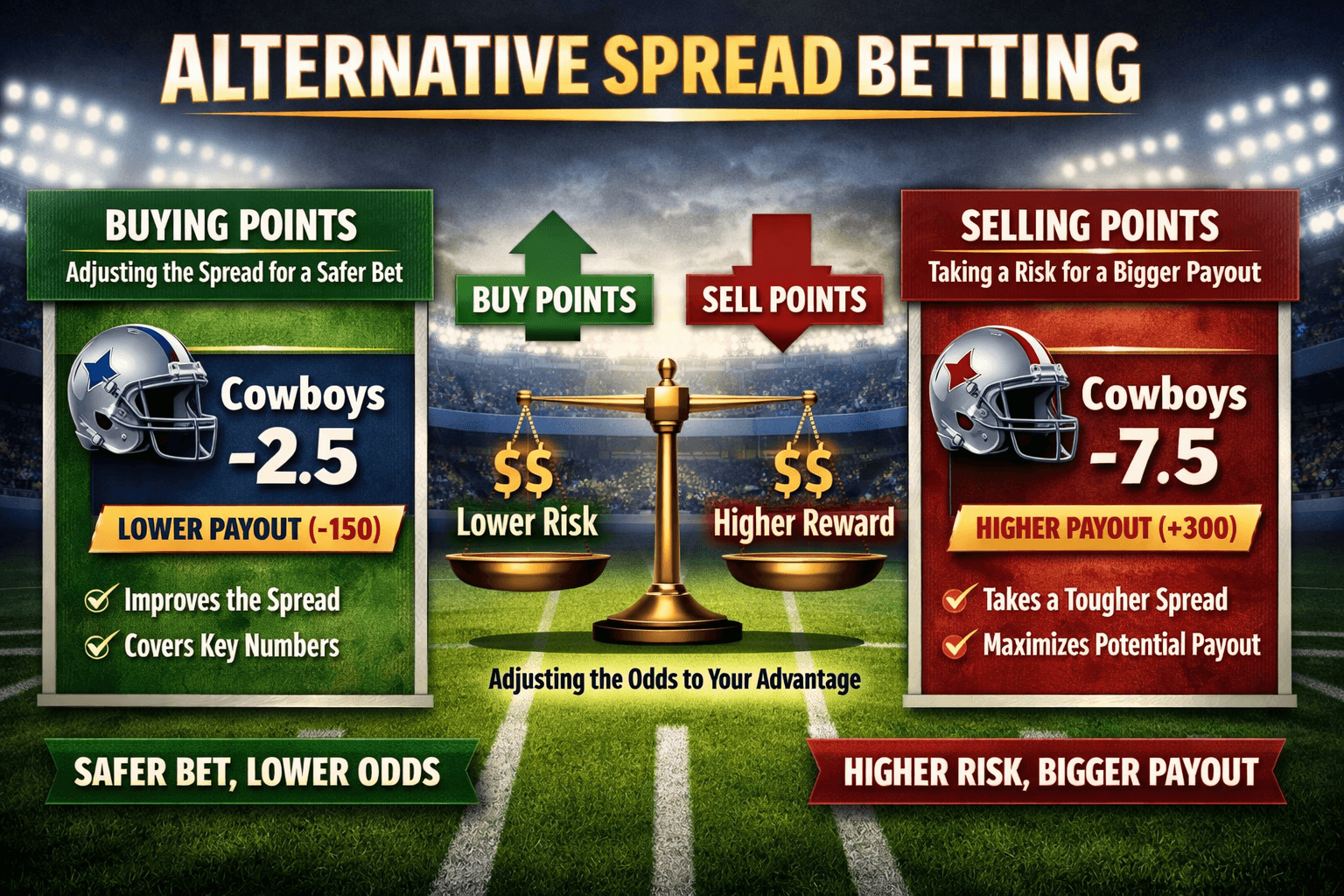
Alternative spread betting refers to wagering on a point spread different from the standard main line set by oddsmakers, adjusting the payout odds accordingly. Bettors can "buy" points (improving the spread for a lower payout) to cover key numbers or "sell" points (taking a harder spread for a higher payout) to capitalize on perceived mispricing.
Table of Contents
Alternative spread betting is often dismissed by casual bettors as a novelty or misunderstood as simply "teasing" a game. However, for the sharp bettor, the alternative market represents one of the most flexible tools in a portfolio. It transforms a binary win/loss proposition into a spectrum of risk and reward, allowing you to manipulate the price of a wager to match your specific handicap of the game script.
The standard spread (e.g., Chiefs -3 at -110) is merely the market equilibrium—the point where the sportsbook expects to balance action. It is not necessarily the "correct" prediction of the margin of victory. By utilizing alternative spreads, you stop accepting the sportsbook's default terms and start defining your own.
This guide explores the mechanics, mathematics, and strategic deployment of alternative spreads, moving beyond basic definitions into the nuance of key numbers, synthetic hold, and price elasticity.
The Mechanics of Price Elasticity#
At its core, alternative spread betting is an exercise in price elasticity. You are trading probability for price.
- Buying Points: You accept a lower payout (or pay a higher price) to move the spread in your favor.
- Selling Points: You accept a more difficult spread to increase your potential payout (often moving from minus odds to plus odds).
The critical error most intermediate bettors make is assuming the cost of a half-point is linear. It is not. In the NFL, moving from -3 to -2.5 is exponentially more expensive than moving from -9 to -8.5, because the probability of a game landing on 3 is significantly higher than landing on 9.
Sportsbooks use sophisticated algorithms to price these alternative lines, often baking in a higher theoretical hold (vig) on alt lines compared to the main line. The "tax" on an alt line might be 5-6%, whereas a sharp main line might only have a 4% hold. Therefore, a blind strategy of always buying points is a guaranteed way to bleed ROI. The goal is to identify specific scenarios where the true probability of the alt line covering exceeds the implied probability of the adjusted odds.
The Mathematics of Buying Points#
"Buying points" is the most common form of alternative spread betting, often done to cross a key number.
The Cost of the Hook
Let’s look at an NFL scenario. Main Line: Bills -3.5 (-110) Alt Line: Bills -2.5 (-145)
Here, you are paying 35 cents of juice to cross the number 3. Is it worth it? To break even at -110, you need to win 52.38% of the time. To break even at -145, you need to win 59.18% of the time.
By buying that point, you are asserting that the probability of the game landing exactly on the Bills winning by 3 is greater than the difference in break-even percentages (approx. 6.8%). If historical data suggests the push rate on 3 is around 15%, this might look like a good deal. However, sportsbooks know this. They inflate the price of crossing the 3 specifically because they know sharps value it.
The "Worm" Concept
In lower-scoring environments or markets with high efficiency (like the NFL closing line), buying points is rarely +EV long-term because the books overcharge for the premium numbers. However, in college football or the NBA, where volatility is higher, the "cost" per point is often flatter.
Sharp Tip: generally, you should avoid buying points on the favorite unless you are crossing zero or a primary key number (3, 7 in NFL) and your model indicates the price adjustment is inefficient.
Selling Points: The Aggressive Edge#
While buying points is defensive, selling points is offensive. This is where sharps often find the most value, particularly in "blowout" game scripts.
If you handicap a game and believe the favorite, listed at -6.5, will dominate, betting them at -6.5 (-110) is fine. But if your model projects a double-digit victory, the standard line limits your upside.
Main Line: 49ers -6.5 (-110) Alt Line: 49ers -9.5 (+160)
Here, you are "selling" three points. You are taking on the risk that the 49ers win by 7, 8, or 9 (losing the bet), in exchange for a massive jump in implied probability (from 52.4% break-even down to 38.5% break-even).
This strategy is highly effective when:
- The Favorite is Undervalued: The market is reacting to a recent bad performance, depressing the line.
- Mismatch in Styles: A strong passing offense vs. a depleted secondary often leads to variance that exceeds standard distributions.
- The "Live" Factor: If you are line shopping and see the main line moving toward -7 or -7.5, snatching an alt line of -9.5 at stable plus-money before the market adjusts can offer significant Closing Line Value (CLV).
Using a tool like the EdgeSlip Line Shopper allows you to visualize these discrepancies across books instantly, ensuring you aren't selling points at a book that offers poor odds scaling.
Key Numbers: The Anatomy of the Push#
You cannot effectively bet alternative spreads without memorizing key numbers. These are the margins of victory that occur most frequently due to the scoring structure of the sport.
NFL Key Numbers
- 3: The most critical number. Roughly 15% of NFL games end with a margin of 3.
- 7: The second most common (approx. 9-10%).
- 6, 10, 14: Secondary key numbers.
If you are betting an alt spread that lands you on a dead number (like -5 or -9), you are likely wasting equity.
- Bad Alt Bet: Moving -4.5 to -2.5. You are paying a premium to cross 3 and 4. While crossing 3 is valuable, you paid extra to cross 4, which is a "dead" number (very low frequency).
- Good Alt Bet: Moving +2.5 to +3.5. You are moving from a loss on a field goal to a push/win.
NBA Key Numbers
NBA scoring is more fluid, but key numbers still exist, largely driven by end-game fouling strategies.
- 5 to 9: Common margins due to free throws extending leads or garbage time buckets cutting deficits.
- Double Digits: Blowouts tend to stabilize around 10-15 points.
In the NBA, buying points is generally less valuable than in the NFL because a single possession is worth less relative to the total score. However, selling points in the NBA can be lucrative due to the high variance of three-point shooting. A team that gets hot from deep can easily turn a -4 spread into a 20-point rout.
Synthetic Hold and Hidden Vig#
The biggest trap in alternative markets is the "Synthetic Hold."
On a main line spread (-110/-110), the theoretical hold is roughly 4.54%. When you look at the alt lines, you don't have a direct "opponent" line to compare to, so the hold is harder to see.
For example, a book might offer:
- Alt Spread: Team A -9.5 (+170)
- The "Opposing" Alt: Team B +9.5 (-230)
If you calculate the no-vig probability of these two options, you will often find the hold has jumped to 6% or 7%. The sportsbook charges you a convenience fee for the ability to customize your line.
How to combat this:
- Shop Aggressively: Different books use different curves. FanDuel might charge heavily for crossing key numbers, while DraftKings might have a flatter curve.
- Compare to Main Lines: If the main line is -6.5 (-110), and the alt line is -7.5 (+105), ask yourself: Is one point worth 15 cents of price improvement? Usually, the answer is no. You generally want a larger payout jump to justify the added risk.
Strategic Use Cases for Alt Spreads#
1. The Middle and The Polish Middle
Sharps use alt spreads to create "middles" without waiting for line movement.
- Scenario: You like the Underdog (+7.5) but think the Favorite wins by a field goal.
- The Bet: You bet Underdog +7.5 (Main Line) AND Favorite -2.5 (Alt Line).
- The Win: If the Favorite wins by 3, 4, 5, 6, or 7, you win BOTH bets.
- The Risk: You are paying vig on two bets. If the game falls outside the window, you lose one and win one (minus the juice). This requires precise modeling to ensure the probability of the middle landing justifies the vig cost.
2. Correlated Parlays (SGPs)
Alternative spreads are the engine of the Same Game Parlay (SGP). If you are betting on a Quarterback to throw for 300+ yards (an over), it correlates heavily with his team covering a larger spread. Instead of parlaying Over 280.5 Yards with the main line (-3), you might parlay Over 300 Yards (Alt Prop) with Team -9.5 (Alt Spread). The correlation increases the probability of both hitting simultaneously, often paying out significantly better than the standard line parlay.
3. Avoiding the "Hook" on Teasers
While a traditional teaser buys points across multiple games, single-game alt lines allow you to tease just one side without needing a second leg. If you love a team at -7.5 but hate the hook, taking them at -7 (Push protection) or -6.5 (Win) via an alt line is often mathematically superior to forcing a two-team teaser just to move that one number.
Psychology and Discipline#
The availability of alternative spreads can induce "loss aversion" behavior. Bettors who lack confidence in their handicap often buy points as an insurance policy.
- "I think they win by 7, but let me take -2.5 just to be safe."
This is a losing mindset. If your handicap says they win by 7, betting -2.5 at -180 ruins your long-term expected value. You are paying for insurance you shouldn't need if your handicap is strong. Over a sample of 1,000 bets, paying that extra juice will erode your bankroll faster than the occasional bad beat on the hook.
Conversely, selling points requires a stomach for variance. You will lose bets that would have won on the main line. You might bet -9.5 and the team wins by 8. That is a painful loss. But if the +160 odds accurately reflected a 40% win probability, it was a good bet. Process over results.
Conclusion: precision is the Edge#
Alternative spread betting is not about making the bet "easier" to win; it is about aligning the wager's parameters with your specific prediction of the game state. It allows you to attack specific inefficiencies in the pricing curve that standard lines smooth over.
To succeed:
- Know the key numbers for the specific sport.
- Calculate the implied probability of the alt odds vs. the main line.
- Use alt spreads to express a specific game script (e.g., a blowout), not to hedge your fears.
- Always shop for the best price, as alt line variations between books are massive.
By treating the spread as a fluid spectrum rather than a fixed point, you unlock a new dimension of value in sports betting markets.
Frequently Asked Questions
What is the difference between an alternative spread and a teaser?▼
Is buying the half-point worth it in the NFL?▼
What does it mean to sell points in betting?▼
How do sportsbooks price alternative lines?▼
Can you use alternative spreads in parlays?▼
Related Articles
Football Squares Rules: The Definitive Analytics & Strategy Guide
Master football squares with this data-driven guide. Learn the rules, optimal number probabilities, auction valuation strategies, and how to gain an edge in high-stakes pools.
.png&w=3840&q=75)
Middling in Sports Betting: The Math Behind the Most Profitable Play
Master the art of middling. Learn how to exploit line movements to create risk-free windows where you win both sides of a bet. Advanced strategy for sharps.
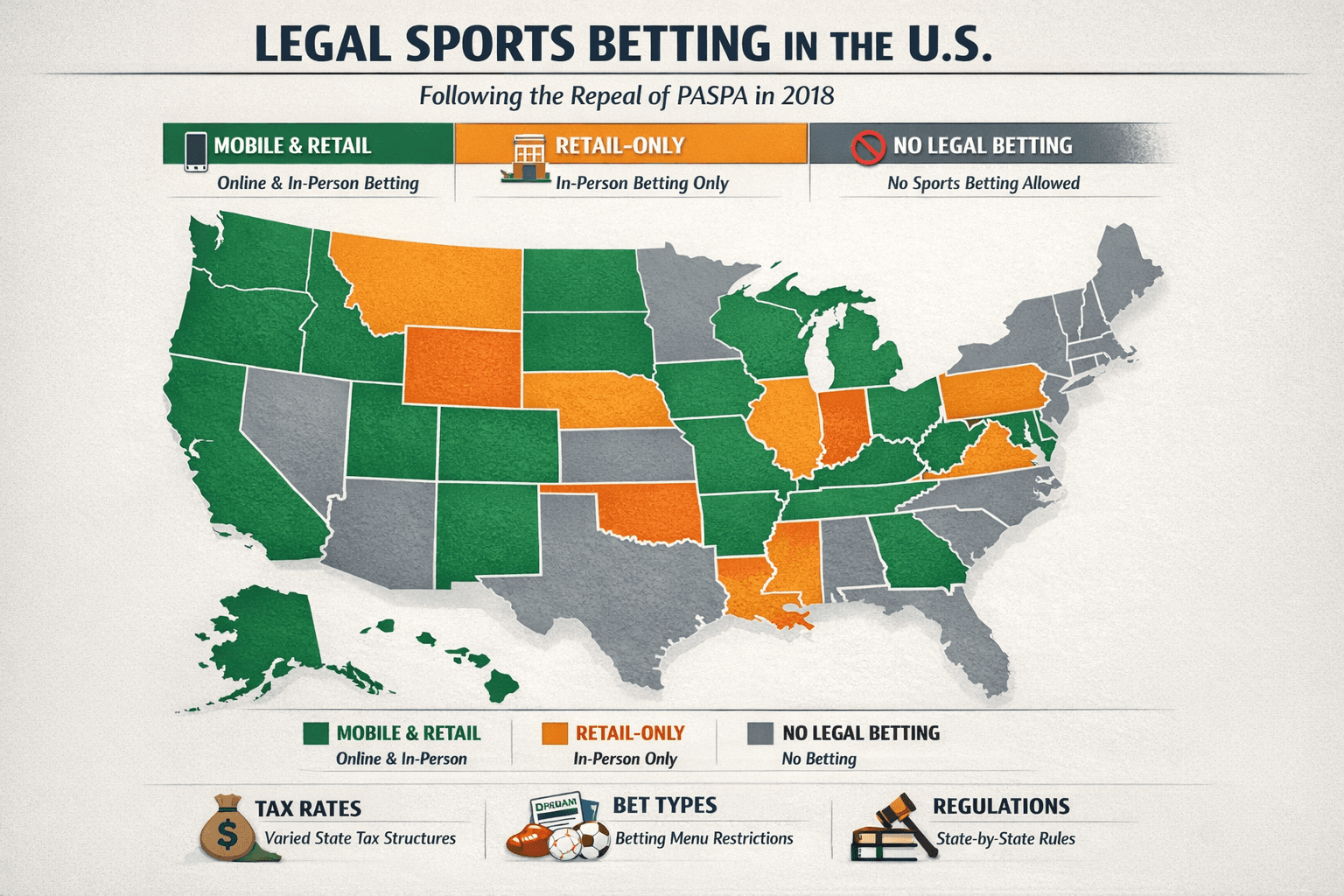
Legal Sports Betting States: 2026 Definitive Sharps Guide
The complete 2026 map of legal US sports betting. Analysis of mobile vs. retail markets, tax impact on odds, prop restrictions, and legislative forecasts.
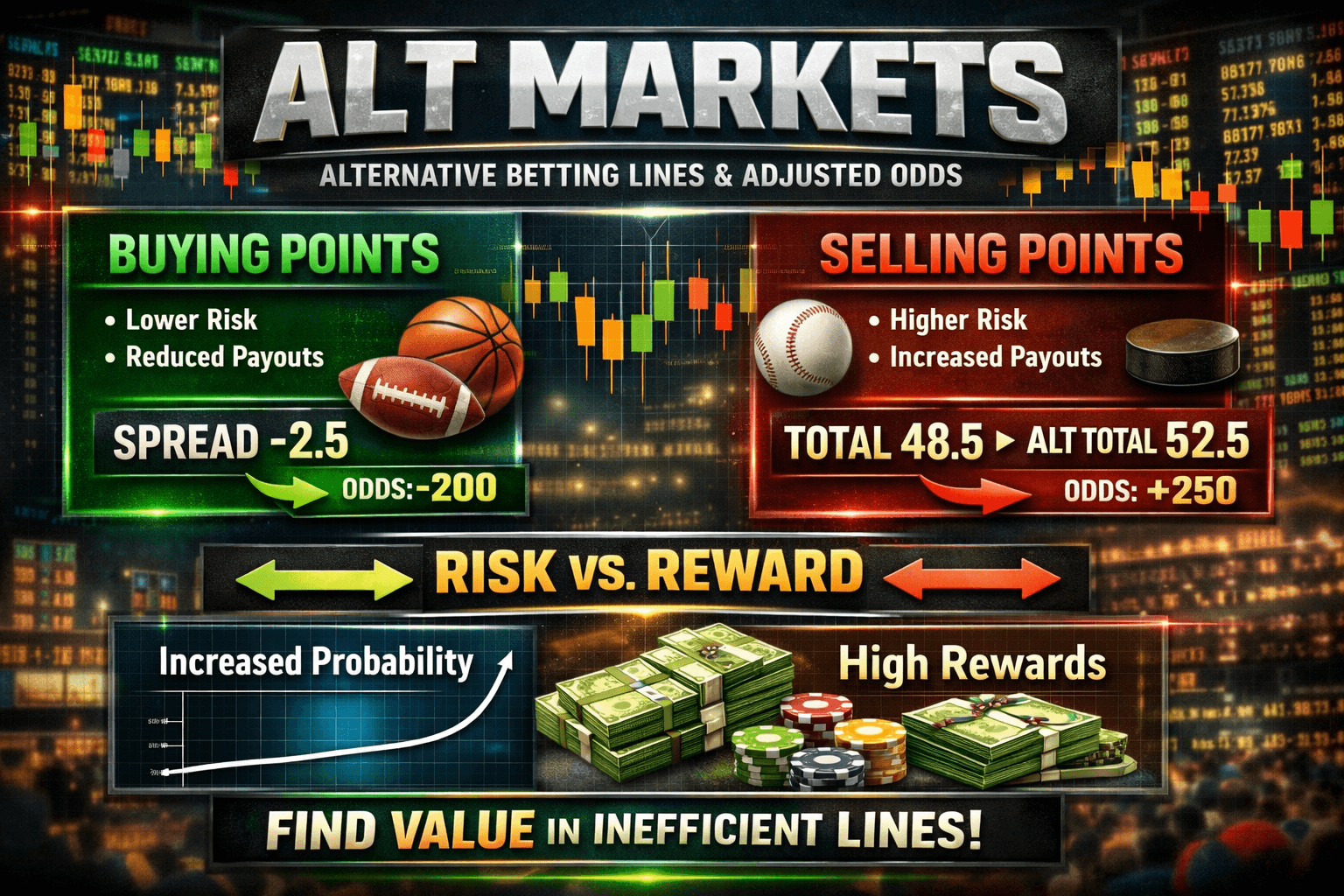
Alt Markets Explained: Exploiting Derivatives for +EV Betting
Master alternate betting markets. Learn how sharps exploit pricing inefficiencies in alt spreads, totals, and props to find edge beyond the main lines.
Ready to find your Edge?
Join thousands of smart bettors who have stopped guessing and started calculating. Access institutional-grade tools for the price of a standard wager.