Football Squares Rules: The Definitive Analytics & Strategy Guide

Key Takeaways
- The Hierarchy of Numbers: In NFL scoring distributions, the numbers 0, 7, and 3 are statistically dominant, while 2, 5, and 9 offer the lowest probability of winning.
- Auction Value Strategy: In auction-style pools, calculate Fair Market Value (FMV) by multiplying the total pot size by the historical win probability of the specific number pair.
- Favorite vs. Underdog Bias: The value of a square is not symmetrical; a 7-0 square favoring the spread favorite is significantly more valuable than 0-7 favoring the underdog.
- Impact of Rule Changes: The shift of the extra point to the 15-yard line has slightly increased scoring variance, making previously 'bad' numbers marginally more viable, though not enough to displace the top tier.
- Hedging Opportunities: High-stakes square holders can utilize live betting markets (totals and spreads) during the 4th quarter to lock in guaranteed profits regardless of the final score outcome.
Definition
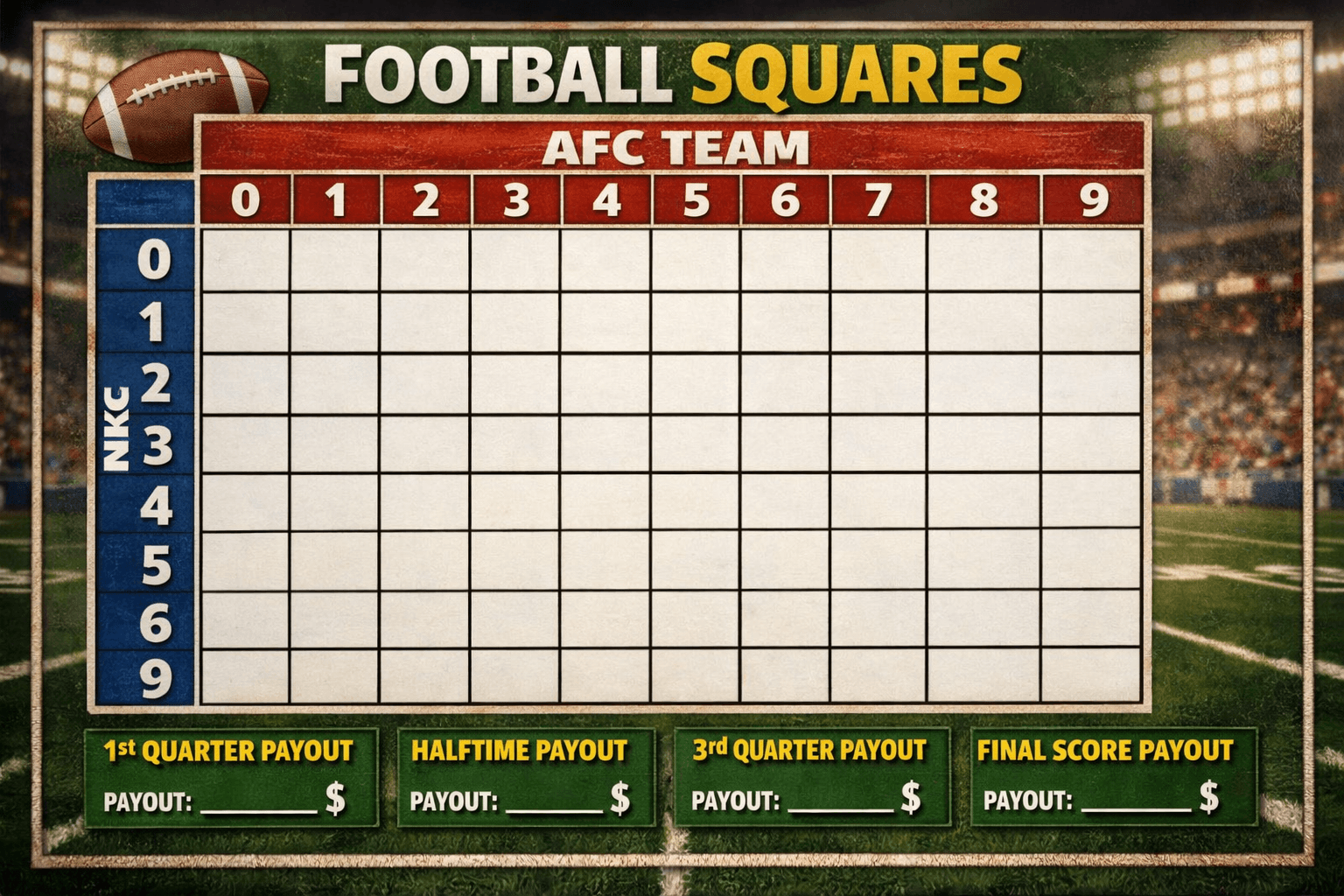
Football squares is a pool-based betting game played on a 10x10 grid where participants purchase cells that correspond to the last digit of each team's score at the end of specific quarters.
Table of Contents
While often dismissed as a casual office party game, Football Squares (or "Super Bowl Squares") presents a fascinating exercise in probability theory and market inefficiency. For the sharp bettor, the 10x10 grid is not merely a lottery; it is a dataset of number frequencies, scoring distributions, and implied probabilities.
Whether you are entering a high-stakes auction pool or simply looking to understand the math behind the madness, this guide breaks down the definitive rules and the advanced analytics required to identify value in the grid.
The Objective: How the Grid Works#
The fundamental mechanics of football squares are standardized, though variations exist. The game utilizes a 10x10 grid, creating 100 individual "squares."
- The Axes: One axis (usually the top row) is assigned to Team A (e.g., the AFC Champion). The other axis (usually the left column) is assigned to Team B (e.g., the NFC Champion).
- The Buy-In: Participants purchase squares before the numbers are drawn. In a standard pool, every square costs the same fixed amount (e.g., $100 per square for a $10,000 pot).
- The Number Draw: Once all 100 squares are sold, numbers from 0 to 9 are randomly drawn and assigned to each row and column.
- The Coordinates: Each square now owns a specific pair of numbers. For example, if your square intersects at Team A (7) and Team B (3), you hold the "7-3" combination.
Determining the Winner
Winners are determined by the last digit of each team's score at the end of specific timeframes—typically the end of the 1st Quarter, Halftime, 3rd Quarter, and the Final Score.
Example Scenario:
- End of 1st Quarter Score: Chiefs 7, 49ers 3.
- Winning Square: The participant holding Chiefs (7) and 49ers (3).
If the score was Chiefs 17, 49ers 13, the winning square remains the same (7-3), as only the second digit counts.
Payout Structures and Variations#
Understanding the payout structure is critical for calculating the Expected Value (EV) of your position, particularly if you are in an auction format where square prices vary.
Standard Payouts
The most common distribution splits the pot evenly among the four quarters, or weights the final score more heavily.
- 25% Split: 25% of the pot goes to the winner of each quarter.
- 20/20/20/40: The first three quarters award 20%, while the final score awards 40%.
"Touching" or "Reverse" Payouts
To keep engagement high, some pools award smaller stipends to squares physically touching the winning square on the grid, or to the "Reverse" score (e.g., if the score is 7-3, the holder of 3-7 also gets paid). While these reduce the variance, they also dilute the EV of holding premium numbers.
The Analytics of Football Squares: Number Frequency#
This is where the casual bettor relies on luck, and the sharp bettor relies on data. NFL scores are not normally distributed. Due to the unique scoring values in football (3 points for a field goal, 7 for a touchdown + PAT), certain digits appear with vastly higher frequency than others.
If you have the opportunity to pick your squares—or bid on them—understanding the hierarchy of digits is the difference between a +EV investment and a donation.
The Tier 1 Numbers: 0, 7, 3
Historically, these three numbers are the gold standard of football squares.
- 0: The most valuable number. Games often start 0-0. Scores like 10, 20, and 30 are common.
- 7: The standard touchdown output. 7, 17, 27 are staple scores.
- 3: Field goals and key outcomes (13, 23).
The Tier 2 Numbers: 4, 1, 6
- 4: Often 14 (two touchdowns) or 24 (three touchdowns + field goal).
- 1: Common in final scores (21, 31) and becoming more common with missed PATs or 2-point conversions.
- 6: While 6 used to be a premium number (two field goals or a missed PAT touchdown), its value has fluctuated with modern kicking rules.
The "Dead" Numbers: 2, 5, 8, 9
These are mathematically the worst numbers to hold. They require non-standard scoring combinations (safeties, missed conversions, multiple field goals) to hit.
- 2 and 5: Often widely considered the worst numbers on the board.
- 8: Can be hit via 28 (4 TDs), but is statistically rare compared to 0 or 7.
- 9: Requires a missed PAT on a third touchdown or three field goals to hit early.
The Impact of Rule Changes
Sharps must adjust their priors based on the NFL's decision to move the extra point back to the 15-yard line. This has slightly increased the variance of scoring. Missed extra points make scores ending in 6 slightly less guaranteed and scores ending in 9 or 0 slightly more volatile. However, the core hierarchy (0, 7, 3) remains the dominant strategy.
Advanced Strategy: The Auction Format#
In sophisticated circles, the "random draw" is replaced by an auction. This is the purest form of the game and aligns perfectly with the mindset of a trader. In an auction, every pair of numbers (or every empty square) is bid upon.
Calculating Fair Value
To win an auction, you must estimate the Fair Market Value (FMV) of a specific number combination.
If the total pot is expected to be $10,000, and historical data suggests the "0-0" square wins 5% of the time (across all quarters), the FMV of that square is $500. If you can buy it for $350, you have generated Positive Expected Value (+EV).
This is identical to the philosophy we use in our Live +EV Feed, where we identify discrepancies between sportsbook odds and true probability. In squares, you are the bookmaker setting the line on the value of the grid.
The "Combo" Nuance
In an auction, pay attention to the axes. The "7-0" square is not necessarily equal to the "0-7" square.
- The Favorite vs. Underdog: If the Chiefs are 7-point favorites over the 49ers, the square representing Chiefs 7, 49ers 0 is significantly more valuable than Chiefs 0, 49ers 7.
- Correlation: You must correlate the spread and total to the grid. In a low-total game, 0s and 3s increase in value. In a high-total blowout, 4s and 1s may see increased equity in the 3rd and 4th quarters.
Hedging Your Square#
One of the most overlooked strategies in football squares is hedging. Because the payouts for quarters (especially the final score) can be substantial, you can use the live betting market to lock in a profit.
Scenario: You own the 7-3 square. The game is in the 4th quarter. The score is Team A 27, Team B 13. You are currently winning. If the score holds, or if Team A kicks a FG (30-13) or Team B scores a TD (27-20), you might lose.
However, if the game situation allows, you can live bet the "Over" or "Under" or specific team totals to create a scenario where you win your bet if the score changes, and win the square if the score holds. This requires quick calculations of implied probabilities, similar to using an arbitrage tool.
Specialized Rules & Grid Variations#
While the 10x10 grid is standard, several variations exist to spice up the action or accommodate different group sizes.
The 25-Square Grid
For smaller groups, a 5x5 grid is used. Each participant gets two numbers for each team (e.g., one square represents Team A ending in 0 or 1, and Team B ending in 2 or 3). This drastically increases the hit rate but lowers the payout variance.
Different Numbers Per Quarter
In this variation, the numbers on the axes are re-drawn after every quarter.
- Pro: It prevents one person with the "2-2" square from being dead money for the entire game.
- Con: It eliminates the ability to strategize based on pre-game spread analysis, making it purely a game of random chance rather than a market inefficiency play.
The "Every Score Pays" Rule
Instead of waiting for the end of the quarter, this variation pays out a small amount for every single score change.
- Strategy: This massively inflates the value of 0s and 7s, as games frequently sit on 0-0, 7-0, 7-3, or 7-7 for long periods or transition through these numbers. Numbers like 2, 5, and 9 become virtually worthless here as they are rarely "transition" scores.
Summary: Treating the Grid like a Market#
To consistently profit from football squares (specifically in auction formats or pick-your-square pools), you must divorce yourself from team loyalty and focus entirely on number distribution.
- Respect the Matrix: 0, 7, and 3 control the board.
- Price the Favorite: Adjust value based on who is likely to be leading.
- Identify Inefficiency: In auctions, people often overbid on "birthdays" or "lucky numbers" and underbid on mathematically ugly but statistically viable numbers like 1 or 4.
- Manage the Risk: Don't be afraid to hedge a massive potential payout using live markets.
Football squares may be a game of chance, but like poker or sports betting, the money flows from the intuitive players to the mathematical ones over the long run.
Frequently Asked Questions
What are the best numbers to have in football squares?▼
How do you play football squares with 100 squares?▼
What happens to football squares in overtime?▼
How does an auction style football pool work?▼
Can you use 25 squares instead of 100?▼
Related Articles
.png&w=3840&q=75)
Middling in Sports Betting: The Math Behind the Most Profitable Play
Master the art of middling. Learn how to exploit line movements to create risk-free windows where you win both sides of a bet. Advanced strategy for sharps.
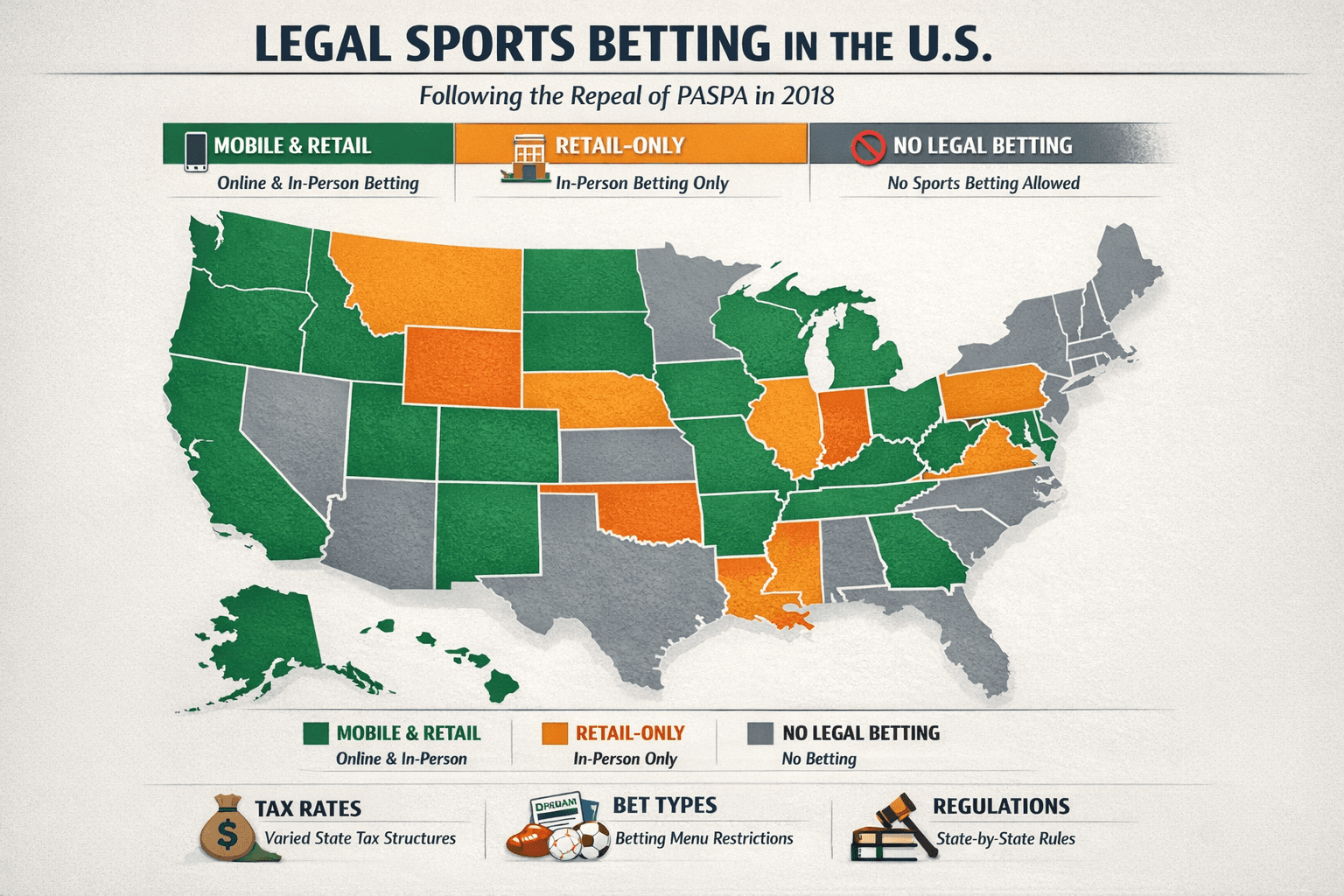
Legal Sports Betting States: 2026 Definitive Sharps Guide
The complete 2026 map of legal US sports betting. Analysis of mobile vs. retail markets, tax impact on odds, prop restrictions, and legislative forecasts.

Alt Markets Explained: Exploiting Derivatives for +EV Betting
Master alternate betting markets. Learn how sharps exploit pricing inefficiencies in alt spreads, totals, and props to find edge beyond the main lines.
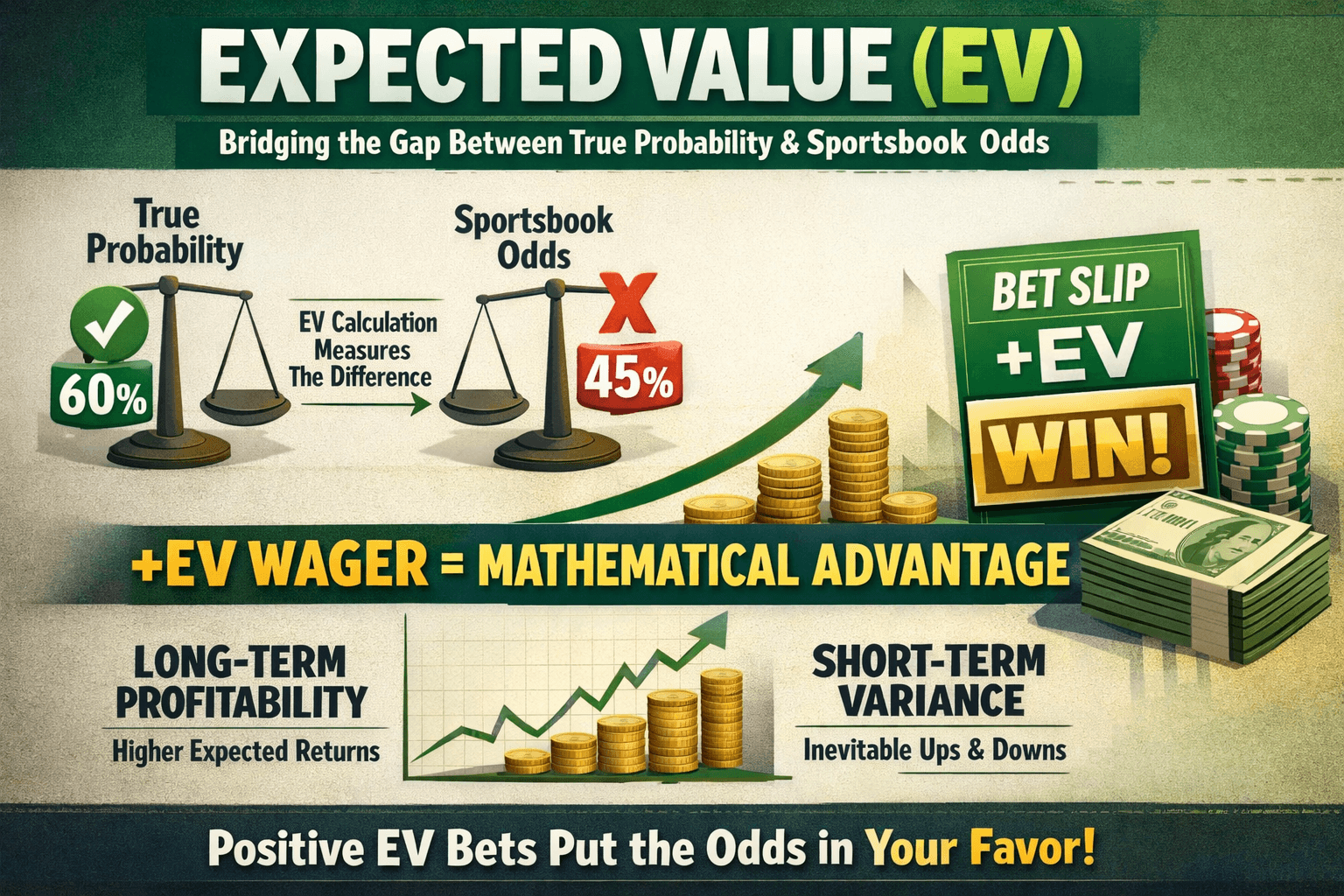
How to Find Expected Value (+EV): The Mathematical Edge
Stop guessing and start trading. Learn how to find Expected Value (+EV) in sports betting using probability theory, market de-vigging, and line shopping.
Ready to find your Edge?
Join thousands of smart bettors who have stopped guessing and started calculating. Access institutional-grade tools for the price of a standard wager.