Asian Handicap Betting: The Definitive Guide for Sharps

Key Takeaways
- The Quarter-Line Advantage: Lines like 0.25 and 0.75 are 'split stakes,' dividing your bet equally between two outcomes (e.g., 0.0 and 0.5) to smooth out variance.
- Variance Reduction: Asian Handicaps allow for 'Half Wins' and 'Half Losses,' protecting bankroll longevity better than binary win/loss markets.
- The Push Mechanic: Integer lines (1.0, 2.0) act as insurance; if the favorite wins by exactly the handicap amount, the bet is void and stakes are returned.
- In-Play Reset Rule: In live soccer betting, Asian Handicap lines typically reset the score to 0-0 at the moment the bet is placed, ignoring prior goals.
- Lower Vig: Asian Handicap markets traditionally have lower bookmaker margins (theoretical hold) compared to 1X2 or prop markets, offering better long-term EV.
Definition
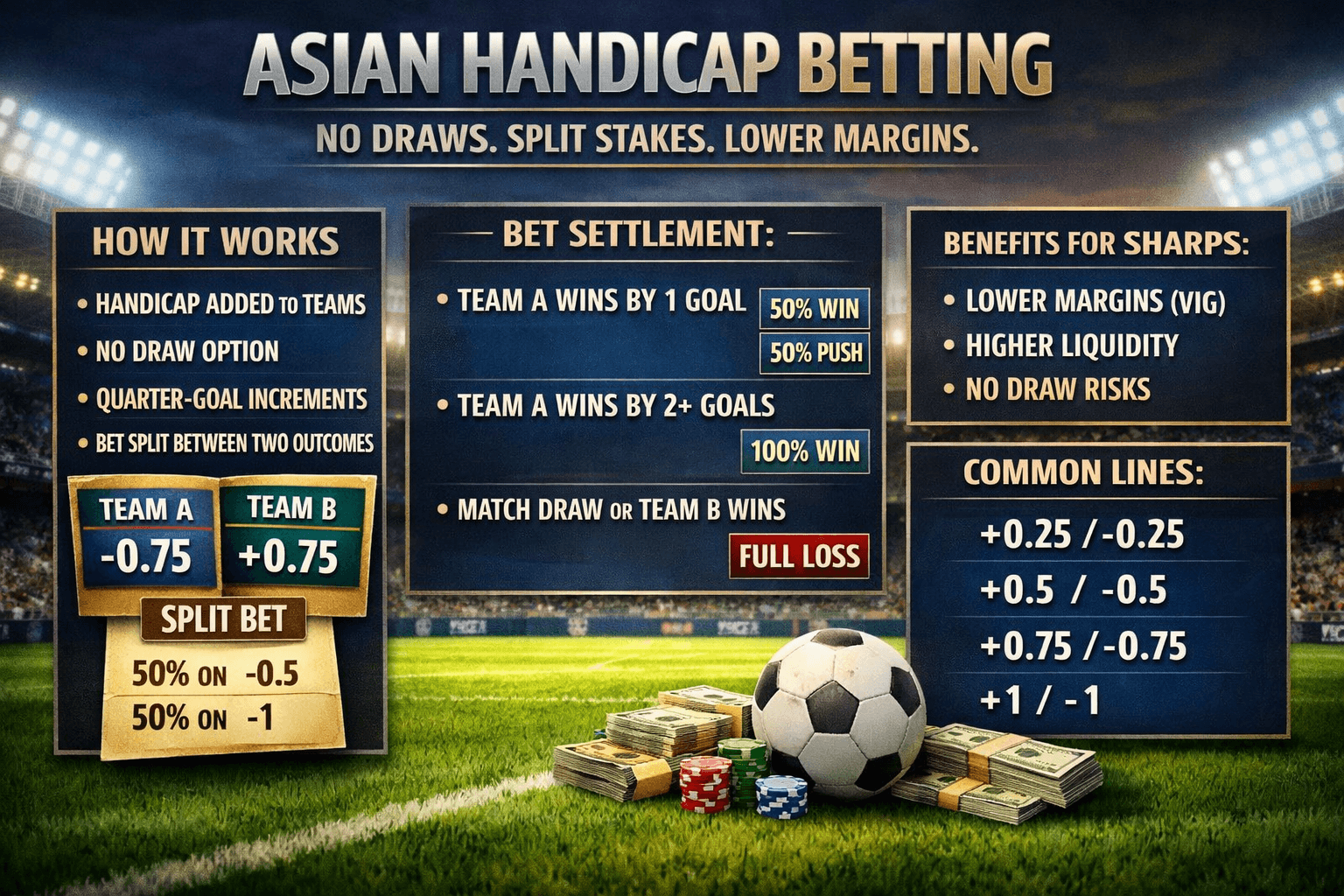
Asian Handicap is a two-way betting market that eliminates the draw option by applying a goal handicap to teams, often using quarter-goal increments (0.25, 0.75) to split stakes between two outcomes. This market is preferred by professional bettors for its lower margins (vig) and higher liquidity compared to standard 1X2 markets.
Table of Contents
Asian Handicap betting is the lingua franca of the professional sports betting world. While recreational bettors often stick to moneylines or standard spreads, high-volume bettors and syndicates operate almost exclusively within the Asian markets.
Why? The answer lies in market efficiency. Originating in Indonesia ("Hang Cheng"), this system was designed to eliminate the draw (the "X" in the 1X2 market), reducing the outcomes from three to two. But for the modern sharp, the appeal isn't just about simplification—it is about margin and risk management.
Asian Handicap markets typically operate with significantly lower theoretical hold (vig) than standard markets. While a recreational book might hold 5-8% on a Player Prop or a standard 3-way line, prime Asian markets often operate between 1.5% and 3%. If you are serious about +EV betting, understanding the nuance of quarter-lines and split stakes is not optional; it is fundamental math.
The Mechanics: How Asian Handicaps Work#
At its core, the Asian Handicap applies a virtual deficit or surplus to a team's score before the game begins. If you bet Manchester City -1.0, they must win by 2 or more goals for you to win. If they win by exactly 1, the bet is a "Push" (void), and your stake is returned.
However, the complexity—and the value—lies in the quarter lines (0.25, 0.75). These are not singular bets; they are split stakes.
When you bet on a line like -1.25, you are actually placing two separate bets:
- 50% of your stake on -1.0
- 50% of your stake on -1.5
This mechanism allows for "Half Wins" and "Half Losses," which smoothes out variance over the long term, a critical component of bankroll management for serious handicappers.
The Three Categories of Lines
To master this, we must categorize the lines into three distinct buckets:
- Full Lines (The Push Lines): 0.0, 1.0, 2.0
- Half Lines (The Binary Lines): 0.5, 1.5, 2.5
- Quarter Lines (The Split Lines): 0.25, 0.75, 1.25
1. Full Lines (Integers)
These function exactly like a standard spread where a push is possible.
- 0.0 (Draw No Bet): If the match ends in a draw, your stake is refunded. You win if your team wins.
- -1.0: You need a win by 2+ goals. A win by exactly 1 goal returns your money.
2. Half Lines (Decimals)
These remove the possibility of a push entirely.
- -0.5: This is identical to a standard Moneyline win (in soccer). If they win, you win. If they draw or lose, you lose.
- +0.5: This is identical to "Double Chance" (Win or Draw). If your team wins or draws, you win.
3. Quarter Lines (Splits)
This is where the confusion—and the edge—usually lies.
- -0.25: Half stake on 0.0 (Pick'em), Half stake on -0.5.
- -0.75: Half stake on -0.5, Half stake on -1.0.
The Master Payout Table#
Use this reference table to determine the exact outcome of your wager based on the match result.
| Handicap | Team Result | Bet Result | Payout Mechanics |
|---|---|---|---|
| 0.0 (PK) | Win | Win | Full Payout |
| 0.0 (PK) | Draw | Push | Stake Refunded |
| -0.25 | Win | Win | Full Payout |
| -0.25 | Draw | Half Loss | Lose 50% of stake; 50% refunded |
| -0.50 | Win | Win | Full Payout |
| -0.50 | Draw | Loss | Full Loss |
| -0.75 | Win by 2+ | Win | Full Payout |
| -0.75 | Win by 1 | Half Win | Win 50% of bet at odds; 50% push |
| -1.00 | Win by 1 | Push | Stake Refunded |
| +0.25 | Draw | Half Win | Win 50% of bet at odds; 50% push |
| +0.75 | Lose by 1 | Half Loss | Lose 50% of stake; 50% refunded |
Mathematical Edge: Why Sharps Prefer Asian Lines#
You will rarely see a professional bettor waste liquidity on a "To Win To Nil" prop bet or a standard 3-way line if an equivalent Asian line exists. There are three primary reasons for this preference: The Vig, The Push, and The Limit.
1. Reduced Vig (Market Hold)
The Asian market is a high-volume, low-margin ecosystem. Because it is a two-way market (Team A vs. Team B + Handicap), bookmakers can balance their books more efficiently than in a 3-way market (Team A, Draw, Team B).
- Standard 1X2 Hold: Often 5% to 7%.
- Asian Handicap Hold: Often 2% to 3% (and even lower at sharp offshores).
Over a sample size of 1,000 bets, paying 2.5% juice versus 5% juice is the mathematical difference between a bankrupt bettor and a profitable professional.
2. Variance Reduction via Quarter Lines
Betting -1.25 instead of -1.5 is a defensive move. If the favorite wins by exactly one goal (a very common margin in low-scoring sports like soccer), the -1.5 bettor loses 100% of their equity. The -1.25 bettor only loses 50%. Preserving capital during "bad beats" allows the compound growth of a bankroll to continue uninterrupted.
3. Higher Limits
Because Asian Handicaps are the primary vehicle for global syndicates, sportsbooks offer their highest limits on these lines. You might be limited to $500 on a player prop, but able to get down $20,000 on a Premier League Asian Handicap line.
Strategic Implementation#
How do we apply this to a data-driven strategy? It requires looking for discrepancies between the implied probability of the 1X2 market and the Asian lines.
The "Half-Loss" Strategy
Consider a scenario where you are backing a heavy underdog.
- Market: Team A (Underdog) vs Team B (Favorite).
- Standard Line: Team A +0.5 is priced at -130 (1.76).
- Asian Line: Team A +0.75 is priced at -150 (1.66).
Many novice bettors balk at the higher price (lower odds) of the +0.75. However, the +0.75 line offers insurance against a 1-goal loss. If Team A loses 0-1:
- The +0.5 bettor loses 100% of their stake.
- The +0.75 bettor loses only 50% of their stake.
If your model predicts a tight, low-scoring game, paying the premium for the quarter-ball coverage is often +EV because it removes the "fatal" nature of the single-goal loss.
Identifying Value with Line Shopping
Not all books move their Asian lines in unison. One book might hold a line at -0.75 @ -110, while another has moved to -1.0 @ +105.
- At -0.75, a 1-goal win is a Half Win.
- At -1.0, a 1-goal win is a Push.
Depending on your risk tolerance and win probability, one of these is mathematically superior. To instantly identify which sportsbook is offering the best line for your specific handicap preference, you should utilize a Line Shopper. This tool aggregates real-time odds across major sportsbooks, highlighting arbitrage opportunities and rogue lines in the Asian market.
Advanced Concepts: In-Play Asian Lines#
Live betting (In-Play) Asian Handicaps differs slightly from pre-match betting. In almost all Asian Handicap live markets, the scoreline is reset to 0-0 at the moment you place the bet.
The Golden Rule of Live Asian Handicaps: It does not matter what the current score is. You are betting on the outcome of the remainder of the match.
Example:
- Current Score: Team A leads 2-0. Time: 60th minute.
- The Bet: You bet Team A -0.5 (Live Asian Handicap).
- The Requirement: Team A must score more goals than Team B from the 60th minute onwards.
- The Result: The match ends 2-0.
- For the match, Team A won.
- For your bet, the "mini-match" ended 0-0. You Lose.
This is distinct from standard "Spread" betting in US sports (like the NFL), where the handicap is applied to the final score regardless of when the bet was placed. In Global Soccer Asian markets, the reset rule is standard. Always check your specific sportsbook's house rules, but assume the 0-0 reset applies unless stated otherwise.
Converting 1X2 Odds to Asian Handicap#
Sometimes value is hidden in the conversion. A "Draw No Bet" (DNB) is mathematically identical to a 0.0 Asian Handicap. However, sportsbooks often price them differently due to how they manage liability in different pools.
If you see:
- Draw No Bet: -140
- Asian Handicap 0.0: -130
You are looking at the exact same wager with a significantly better price on the Asian line. Always check the 0.0 line before placing a DNB wager.
Summary#
The Asian Handicap is not just a betting type; it is a tool for variance reduction and precision. It allows you to:
- Eliminate the Draw: Turn a 3-outcome event into a 2-outcome event.
- Split Your Risk: Use quarter lines (0.25, 0.75) to mitigate losses on tight games.
- Pay Less Juice: Benefit from the tightest margins in the sports betting industry.
For the serious bettor, moving from recreational markets to Asian Handicaps is the first step toward professional account management. The complexity of the quarter-line is the barrier to entry that keeps the casual public out—and the value high for those who understand the math.
Frequently Asked Questions
What does +0.25 mean in Asian Handicap betting?▼
What is the difference between Asian Handicap and a standard spread?▼
What happens if I bet -1.0 Asian Handicap and my team wins by 1?▼
How does live Asian Handicap betting work?▼
Is Asian Handicap 0.0 the same as Draw No Bet?▼
Related Articles
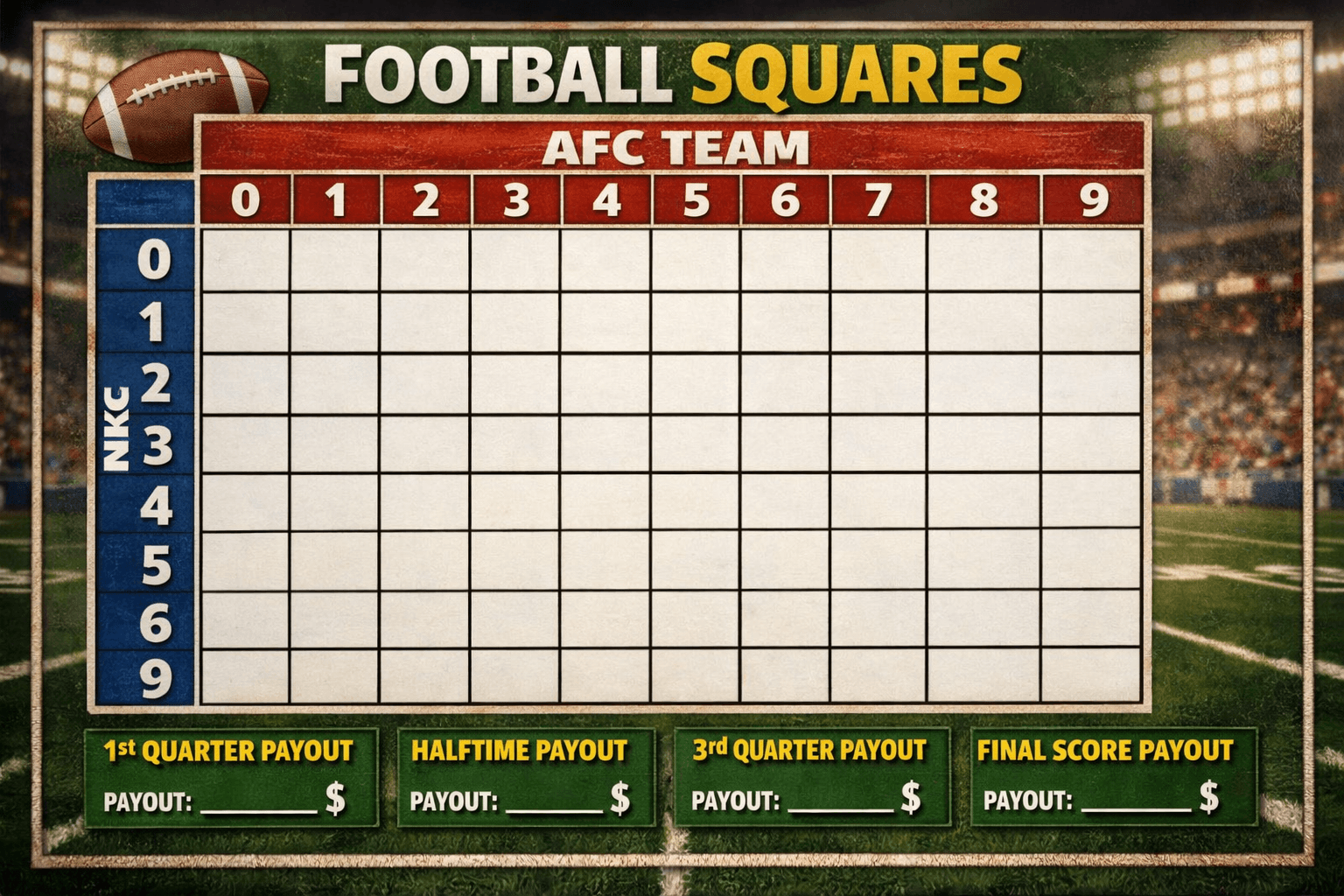
Football Squares Rules: The Definitive Analytics & Strategy Guide
Master football squares with this data-driven guide. Learn the rules, optimal number probabilities, auction valuation strategies, and how to gain an edge in high-stakes pools.
.png&w=3840&q=75)
Middling in Sports Betting: The Math Behind the Most Profitable Play
Master the art of middling. Learn how to exploit line movements to create risk-free windows where you win both sides of a bet. Advanced strategy for sharps.
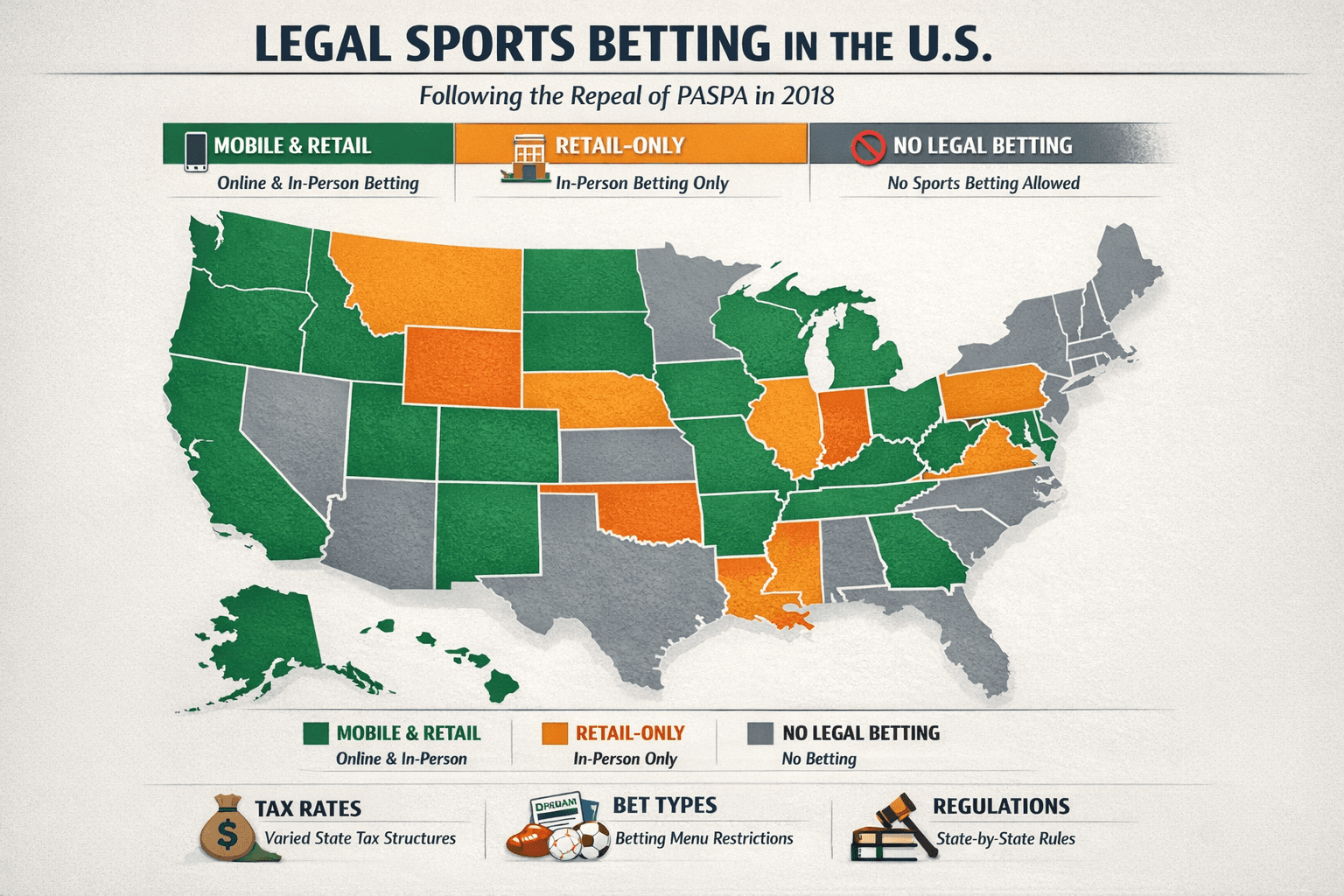
Legal Sports Betting States: 2026 Definitive Sharps Guide
The complete 2026 map of legal US sports betting. Analysis of mobile vs. retail markets, tax impact on odds, prop restrictions, and legislative forecasts.

Alt Markets Explained: Exploiting Derivatives for +EV Betting
Master alternate betting markets. Learn how sharps exploit pricing inefficiencies in alt spreads, totals, and props to find edge beyond the main lines.
Ready to find your Edge?
Join thousands of smart bettors who have stopped guessing and started calculating. Access institutional-grade tools for the price of a standard wager.